Written by: Thailandfocusguide Consular & Border Regulatory Desk (Cross-Border Regulatory & Consular Policy Desk)
Fact-Checked & Reviewed by: Thailandfocusguide Consular Policy & Travel Standards Council (European Consular Law & Visa Compliance Panel)
Standards: Current Regulatory Edition | Verified Cross-Border Policy | Zero Commercial Bias | Direct regulatory verification against official European Commission DG HOME & Consular Treaties
Guidelines: Directly cross-verified against official European Commission DG HOME and U.S. Department of State Consular Affairs.
Consular & Border Standards: Entry requirements, visa validity, and short-stay rules reflect official European Commission and U.S. Department of State consular protocols current as of 2025–2026.
The 60-day visa exemption for United States passport holders originates from the Cabinet Resolution of May 28, 2024, codified by Ministry of Interior Notification issued under Immigration Act B.E. 2522, Section 12(7) and Section 17. The directive was formally promulgated in the Royal Gazette (Ratchakitcha), Volume 141, Special Section 193 Ngor, on July 15, B.E. 2567 (2024). While the entitlement is operative nationwide, travelers must verify current implementation directives with the Thai Immigration Bureau before departure, as individual border checkpoints retain statutory discretion to inspect supporting documentation.
US passport holders enter Thailand visa-free up to 60 days. Thailand visa exemption rules 2025 grant direct entry stamp at port. Foreign travelers skip pre-application. Advance visa fee equal zero. Electronic travel clearance not exist for Thailand in 2025. Stamp validity starts calendar day of arrival. Day 60 marks departure deadline. Travelers confuse airline check-in rules, overstay bans, domestic extension steps. Costly boarding denials follow.
Statutory Authority Under Thailand Visa Exemption Rules 2025
Immigration Act B.E. 2522 govern entry permissions. Section 12 establish inadmissibility criteria. Section 17 grant Cabinet power for special exemptions. Thailand visa exemption rules 2025 operate under Ministry of Interior notifications issued under Section 17 authority.
Entry officers inspect documents at immigration checkpoints. Suvarnabhumi, Don Mueang, Phuket, Chiang Mai process biometric scans. Officers stamp entry date plus 59 days. Total stay equal 60 calendar days. Passport must show 30 days validity past departure date. Airlines demand six months passport validity. Passenger present short passport risk check-in refusal at origin. Thailand visa exemption rules 2025 require onward transportation proof within authorized stay limit.
Thailand Visa Exemption Rules 2025: Entry Classes Compared
Selection of correct entry authorization prevents border friction. Table below compares legal options under Thailand visa exemption rules 2025.
| Entry Class | Statutory Basis | Initial Stay | Extension Limit | Government Fee | Advance Application |
|---|---|---|---|---|---|
| Visa Exemption (US Passport) | Immigration Act B.E. 2522, Sec 17 | 60 days | +30 days (TM.7) | Free at port | None |
| Tourist Visa Single Entry (TR) | Ministerial Regulation | 60 days | +30 days (TM.7) | $40 USD | Royal Thai Embassy / e-Visa |
| Tourist Visa Multiple Entry (METV) | Ministerial Regulation | 60 days per entry | +30 days per entry | $200 USD | Royal Thai Embassy / e-Visa |
| Destination Thailand Visa (DTV) | Cabinet Resolution 2024 | 180 days per entry | +180 days | 10,000 THB | Royal Thai Embassy / e-Visa |
| Non-Immigrant B (Employment) | Immigration Act B.E. 2522, Sec 34 | 90 days | 1 year renewable | $80–$200 USD | Thai Embassy + Work Permit |
| Thailand Privilege Card | Royal Gazette Order | 5–20 years | Annual stamp | 900,000+ THB | Direct program application |
Thailand visa exemption rules 2025 provide fastest entry path for stays under two months. Longer stays require formal visa classes or domestic extensions before day 60 expires.
Stay Extension Protocols: TM.7 and TM.30 Compliance
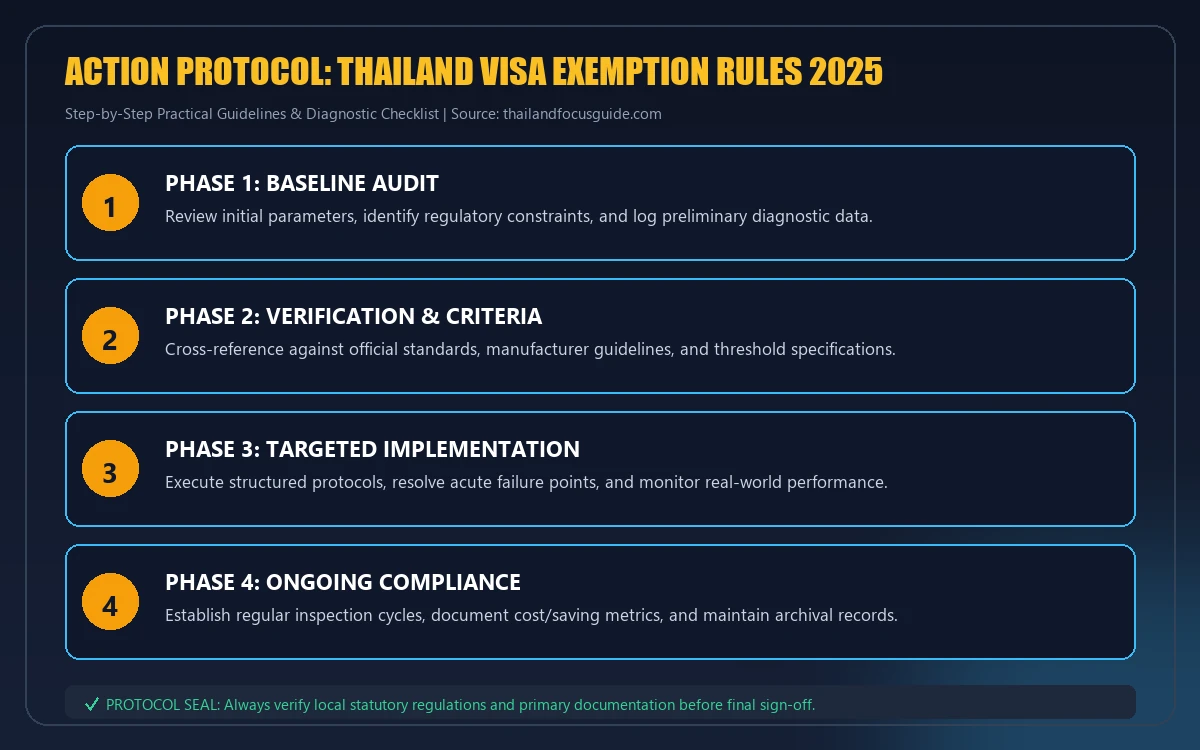
Travelers needing additional stay beyond 60 days must file administrative extensions inside Thailand. Thailand visa exemption rules 2025 permit one 30-day extension per entry stamp. Late filing constitutes unlawful presence under Section 81 of Immigration Act B.E. 2522.
Execute TM.7 filing using the following ordered sequence:
- Verify TM.30 Address Registration: Obtain the physical TM.30 receipt from the hotel, landlord, or property host. Immigration Act B.E. 2522, Section 38, supplemented by Ministerial Regulation No. 14 B.E. 2535, mandates that property owners submit foreign tenant addresses within 24 hours of arrival. Officers cross-check database records and refuse TM.7 processing if TM.30 registration is missing.
- Prepare Statutory Application Packet: Assemble the original passport, one photocopy of the bio page, one photocopy of the current 60-day exemption stamp, one passport photograph (4×6 cm, white background, taken within six months), and a fully completed Form TM.7.
- Submit at Provincial Immigration Office: Present documents at the competent provincial immigration office (such as Bangkok Chaeng Wattana, Phuket Town, or Chiang Mai Promenada) during the final 7 to 14 days of lawful stay.
- Pay Statutory Fee and Receive Endorsement: Remit the 1,900 THB government fee in cash. Receive the TM.7 extension stamp granting exactly 30 additional days counted from the original stamp expiry date.
Total lawful presence under Thailand visa exemption rules 2025 with TM.7 approval equals 90 days. Second extensions are prohibited on this entry class.
Airline Boarding Verification: IATA Timatic and Return Ticket Mandates
Itineraries collapse before departure. Thailand visa exemption rules 2025 permit 90 total days via extension. Commercial airline reservation systems see only 60-day initial stamp limit.
Automated check-in software cross-reference passenger itineraries against IATA Timatic database rules. System flag outbound return flight booked on day 75 as documentation deficiency. Check-in kiosks block boarding pass generation. Gate agents enforce strict transit standards to avoid carrier fines under Chicago Convention Annex 9 immigration liabilities. Carriers instruct counter staff to verify onward travel within 60 days before issuing boarding passes.
Informal verbal explanations about planned TM.7 extension fail counter audits. Passenger must purchase refundable outbound ticket leaving Thailand before day 60. Cancel refundable ticket after arrival and extension approval. Thailand visa exemption rules 2025 demand verifiable proof of exit within primary authorization window.
Thailand Visa Exemption Rules 2025 and Multi-Leg Itineraries: Schengen Travel Requirements
Combined trips demand separate regulatory planning. Thailand visa exemption rules 2025 reset stay allowances per arrival stamp. European transit follows different statutory framework.
Schengen Borders Code (Regulation EU 2016/399) restricts short stays to 90 days inside any rolling 180-day window across 29 European states. Time spent in member countries pools into single limit. Exit plus re-entry not reset European day count. European Union mandates electronic pre-clearance starting 2026. US citizens must file applications via Official European Commission ETIAS Portal before boarding European flights. Authorization fee equals €7 for applicants aged 18 through 70.
Passport rules diverge between jurisdictions. Thailand requires 30 days validity past trip end. U.S. Department of State Germany Travel Advisory mandates minimum three months validity past intended Schengen departure date. Dual-destination itineraries must satisfy European passport validity limits before departure. Thailand visa exemption rules 2025 operate independently of European immigration pools.
Overstay Penalties and Ministry of Interior Order No. 1/2558
Staying beyond the date endorsed on the entry stamp violates Immigration Act B.E. 2522, Section 81. Monetary fines accrue at 500 THB per day up to a statutory ceiling of 20,000 THB, payable at the international port of departure. Overstaying foreign nationals face mandatory blacklisting under Ministry of Interior Order No. 1/2558 (promulgated November 27, B.E. 2558, effective March 20, B.E. 2559).
Under Ministry of Interior Order No. 1/2558, statutory re-entry ban tiers apply based on whether the violator surrenders voluntarily or is apprehended:
Surrendering aliens at immigration departure checkpoints:
- Overstay exceeding 90 days: 1-year re-entry ban.
- Overstay exceeding 1 year: 3-year re-entry ban.
- Overstay exceeding 3 years: 5-year re-entry ban.
- Overstay exceeding 5 years: 10-year re-entry ban.
Apprehended aliens during domestic interior enforcement:
- Overstay up to 1 year: 5-year re-entry ban.
- Overstay exceeding 1 year: 10-year re-entry ban.
Apprehended violators face transfer to the Immigration Detention Center (IDC) Suan Phlu, formal court arraignment, criminal fines, and deportation at personal expense. Thailand visa exemption rules 2025 offer zero statutory grace periods.
Entry Frequency and Land Border Run Enforcement
Immigration Act B.E. 2522 grant officers full discretionary refusal authority. Frequent entries trigger border audits. Thailand visa exemption rules 2025 permit repeat visits, but consecutive exemption stamps flag suspicion of illegal residence or unauthorized remote labor.
Ministry of Interior notifications limit land border visa exemptions to maximum two entries per calendar year. Air entries lack statutory annual ceiling. Immigration Bureau operational directives instruct officers to intercept travelers with three consecutive exemption entries.
Officers inspect personal finances under Immigration Act B.E. 2522, Section 12(2). Traveler must show 20,000 THB cash per person or 40,000 THB cash per family group. Bank account balance displays on mobile screens often get rejected at land posts. Officers demand physical currency or verifiable payment instruments. Failure yields immediate entry denial under Section 12. Carrier returns passenger to origin port at passenger cost. Thailand visa exemption rules 2025 require physical maintenance of funds at inspection gates.
Pre-Departure Checklist Under Thailand Visa Exemption Rules 2025
Complete the following compliance sequence before checking in for international departures to Thailand:
- Verify Passport Validity Window: Inspect the biological passport data page. Ensure the booklet contains at least two blank visa pages and exceeds the 30-day statutory minimum past the departure date. Six months remaining validity is required by commercial airlines.
- Secure Outbound Transportation Proof: Obtain a confirmed, electronic airline ticket showing exit from Thailand within 60 calendar days of arrival. Open-ended reservations or travel agency itineraries without valid PNR ticket numbers do not satisfy airline automated document checks.
- Withdraw Statutory Financial Means: Secure 20,000 THB in physical cash or major convertible currency (approximately $600 USD) per individual traveler, or 40,000 THB per family unit, to present upon officer request under Section 12(2).
- Confirm Address Details for TM.30 Compliance: Download and print hotel confirmations or residential lease agreements showing the full physical address and contact phone number of the host property.
- Monitor TM.6 Arrival Card Suspension Status: Paper TM.6 arrival cards remain temporarily suspended at major international air checkpoints (Suvarnabhumi, Don Mueang, Phuket) pursuant to Cabinet resolutions streamlining airport passenger processing. Land crossings may still issue physical cards depending on provincial operational orders.
Frequently Asked Questions
How do Thailand visa exemption rules 2025 apply to repeat border runs?
Land border arrivals cannot exceed two exemption entries in one calendar year under Ministry of Interior notifications. International air arrivals do not carry fixed annual numerical limits, but Immigration Bureau profiling guidelines target travelers attempting consecutive exemption entries. Officers demand proof of employment abroad, outbound flight tickets, and physical cash. Repeated back-to-back entries without formal long-term visas lead to entry denial and deportation under Section 12.
What statutory requirements govern TM.7 extension filing at provincial immigration offices?
Applicants must submit Form TM.7 before the initial 60-day stamp expires, present the passport, provide one 4×6 cm photograph, pay 1,900 THB in cash, and show a validated TM.30 receipt from their landlord or accommodation provider. Approvals add 30 days to the original expiration date, providing a total lawful stay of 90 days.
Can foreign travelers engage in remote employment while staying on visa-exempt status?
Foreign nationals cannot perform productive labor inside Thailand under exemption status. The Emergency Decree on Non-Thai Working Management B.E. 2560 prohibits work without a valid work permit or appropriate authorization. Remote workers and digital nomads must apply for the Destination Thailand Visa (DTV), which explicitly authorizes remote employment for foreign clients across 180-day stay periods.
How are short overstays handled under documented medical emergency exceptions?
Medical incapacitation does not eliminate statutory 500 THB per day overstay fines automatically. Travelers unable to travel due to hospitalization must obtain an official medical certificate signed by an attending physician with hospital seals. A formal representative can present these medical records at a local immigration office to apply for temporary discretionary stay extensions under humanitarian grounds, mitigating blacklisting penalties.
References
Thai Immigration Bureau — Regulatory Entry Directives and Statutory Procedures
https://www.immigration.go.th
Year: 2025. Official portal establishing entry inspection standards, Form TM.7 stay extension rules, Form TM.30 accommodation reporting duties under Immigration Act B.E. 2522, and discretionary entry refusal thresholds.
Official Journal of the European Union — Regulation (EU) 2016/399 (Schengen Borders Code)
https://eur-lex.europa.eu/eli/reg/2016/399/oj
Year: 2024. Statutory codification of entry conditions, 90/180-day short-stay calculation rules, and biometric border inspection procedures across the Schengen Area.
European Commission DG Migration and Home Affairs — European Travel Information and Authorisation System (ETIAS)
https://travel-europe.europa.eu/etias_en
Year: 2026. Official EU portal establishing electronic travel authorization requirements under Regulation (EU) 2018/1240 for visa-exempt third-country nationals.
U.S. Department of State — Bureau of Consular Affairs Germany International Travel Information
https://travel.state.gov/content/travel/en/international-travel/International-Travel-Country-Information-Pages/Germany.html
Year: 2026. Consular entry advisories, passport validity requirements (minimum 3 months beyond intended departure from Schengen), and emergency assistance protocols.
Royal Gazette of Thailand — Ministry of Interior Notification on Visa Exemption Expansion (B.E. 2567)
http://www.ratchakitcha.soc.go.th
Year: 2024. Volume 141, Special Section 193 Ngor. Published July 15, B.E. 2567. Formal ministerial notification expanding visa-exempt tourist stays to 60 days under Section 17 of Immigration Act B.E. 2522.